Showing posts with label ekphrastic poems. Show all posts
Showing posts with label ekphrastic poems. Show all posts
Wednesday, August 6, 2008

Wednesday, July 30, 2008
The Curator
Here is the story, now, that I want to tell you.
Early one day, a dark December morning,
we came on three young soldiers waiting outside,
pacing and swinging their arms against the cold.
They told us this: in three homes far from here
all dreamed of one day coming to Leningrad
to see the Hermitage, as they supposed
every Soviet citizen dreamed of doing.
Now they had been sent to defend the city,
a turn of fortune the three could hardly believe.
I had to tell them there was nothing to see
but hundreds and hundreds of frames where the paintings had hung.
“Please, sir,” one of them said, “let us see them.”
And so we did. It didn’t seem any stranger
than all of us being here in the first place,
inside such a building, strolling in snow.
We led them around most of the major rooms,
what they could take the time for, wall by wall.
Now and then we stopped and tried to tell them
part of what they would see if they saw the paintings.
I told them how those colors would come together,
described a brushstroke here, a dollop there,
mentioned a model and why she seemed to pout
and why this painter got the roses wrong.
from Miller Williams' poem The Curator
Early one day, a dark December morning,
we came on three young soldiers waiting outside,
pacing and swinging their arms against the cold.
They told us this: in three homes far from here
all dreamed of one day coming to Leningrad
to see the Hermitage, as they supposed
every Soviet citizen dreamed of doing.
Now they had been sent to defend the city,
a turn of fortune the three could hardly believe.
I had to tell them there was nothing to see
but hundreds and hundreds of frames where the paintings had hung.
“Please, sir,” one of them said, “let us see them.”
And so we did. It didn’t seem any stranger
than all of us being here in the first place,
inside such a building, strolling in snow.
We led them around most of the major rooms,
what they could take the time for, wall by wall.
Now and then we stopped and tried to tell them
part of what they would see if they saw the paintings.
I told them how those colors would come together,
described a brushstroke here, a dollop there,
mentioned a model and why she seemed to pout
and why this painter got the roses wrong.
from Miller Williams' poem The Curator
Sunday, June 1, 2008
Archaic Torso of Apollo--Rainer Maria Rilke

We cannot know his legendary head
with eyes like ripening fruit. And yet his torso
is still suffused with brilliance from inside,
like a lamp, in which his gaze, now turned to low,
gleams in all its power. Otherwise
the curved breast could not dazzle you so, nor could
a smile run through the placid hips and thighs
to that dark center where procreation flared.
Otherwise this stone would seem defaced
beneath the translucent cascade of the shoulders
and would not glisten like a wild beast's fur:
would not, from all the borders of itself,
burst like a star: for here there is no place
that does not see you. You must change your life.
Translated by Stephen Mitchell
Thursday, May 29, 2008
Keats-On Seeing the Elgin Marbles
On Seeing the Elgin Marbles--John Keats
My spirit is too weak—mortality
   Weighs heavily on me like unwilling sleep,
   And each imagined pinnacle and steep
Of godlike hardship tells me I must die
Like a sick eagle looking at the sky.
   Yet 'tis a gentle luxury to weep,
   That I have not the cloudy winds to keep,
Fresh for the opening of the morning's eye.
Such dim-conceived glories of the brain
   Bring round the heart an indescribable feud;
So do these wonders a most dizzy pain,
   That mingles Grecian grandeur with the rude
Wasting of old Time—with a billowy main—
   A sun—a shadow of a magnitude.
Tuesday, May 27, 2008
A few classic examples of Romantic ekphrasis
 I'll be gone on a writing/editing jag for a day or two, then off on vacation. But in the meantime, I thought I'd post a few classic examples of ekphrasis, mostly from the Romantic poets who made the practice central to lyric poetry, taking it away from more narrative moments in epic poems (think Achilles' shield).
  Here's Shelly's poem on what he believed to be Leonardo's Medusa. However, most scholars now think the version of the mythical character Shelley viewed in Florence is not by Leonardo at all, but by an anonymous Flemish painter. Leonardo's Medusa does not, apparently, survive. So what remains? Ekphrasis.
 On the Medusa of Leonardo Da Vinci in the Florentine Gallery--Percy Bysshe Shelley

It lieth, gazing on the midnight sky,
  Upon the cloudy mountain peak supine;
Below, far lands are seen tremblingly;
  Its horror and its beauty are divine.
Upon its lips and eyelids seems to lie
  Loveliness like a shadow, from which shrine,
Fiery and lurid, struggling underneath,
The agonies of anguish and of death.

Yet it is less the horror than the grace
  Which turns the gazer's spirit into stone;
Whereon the lineaments of that dead face
  Are graven, till the characters be grown
Into itself, and thought no more can trace;
  'Tis the melodious hue of beauty thrown
Athwart the darkness and the glare of pain,
Which humanize and harmonize the strain.

And from its head as from one body grow,
  As [   ] grass out of a watery rock,
Hairs which are vipers, and they curl and flow
  And their long tangles in each other lock,
And with unending involutions shew
  Their mailed radiance, as it were to mock
The torture and the death within, and saw
The solid air with many a ragged jaw.

And from a stone beside, a poisonous eft
  Peeps idly into those Gorgonian eyes;
Whilst in the air a ghastly bat, bereft
  Of sense, has flitted with a mad surprise
Out of the cave this hideous light had cleft,
  And he comes hastening like a moth that hies
After a taper; and the midnight sky
Flares, a light more dread than obscurity.

'Tis the tempestuous loveliness of terror;
  For from the serpents gleams a brazen glare
Kindled by that inextricable error, 35
  Which makes a thrilling vapour of the air
Become a [ ] and ever-shifting mirror
  Of all the beauty and the terror there—
A woman's countenance, with serpent locks,
Gazing in death on heaven from those wet rocks.
Sunday, April 20, 2008
Day 20-Some Prayer

Some Prayer
(an iconoclast longs for several friends)
"The icon is a song of triumph, and a revelation, and an enduring monument to the victory of the saints and the disgrace of the demons." --John of Damascus, On Icons, 2, 2
Someone tonight believe
 in a healing song
 in the hands and their oils
  on the flesh of our brother.

Some hand, tonight, burn
 not as fire
 not as flame
  but as a fierce salve on the skin.

Summon out the venom
 of the cells,
 of the body in the world
  that decays of our own weight.

Some God open, oh icon of yourself,
 open, as a wound, take into yourself
  my brother at his merest.

Summon him, or raise him,
 or return him to us clean
                as a new stone, as a verse in Revelation if you can.
Friday, April 18, 2008
Fourth of Several Manifestos in the Voices of the Dead

Rembrandt Addresses the 1960s and 70s
You will move from black
 and white to color,
  from an etched world

to an urban landscape of vivid oils
 that will scare and stun
  everyone already

drawn in her best grays and blacks on paper,
 line and outline of a leg,
  her covered curves so clear.

Look back, I think, rather than ahead
 to the glossy magazine and the Soup Cans,
  and the neon Dutch Masters

on the billboard just outside the Queens Tunnel.
  You will find your way into photographs
  and acrylics, and will paint

so fiercely at times that your arms
 will go numb. This will go ahead and happen.
  So you’ll need your rest. Lie down.

I will come to you in a series of dreams and whisper
 die meeste ende di naetuereelste beweechgelickheijt
  and you will believe until you wake

that I really did see Christ being lifted from the ground,
 heavy as a plastic sack of seed, fallen from a truck,

that I really did see his guards (like the men
 in the grainy video of Vietnam, Munich,
  Selma, El Salvador, the Moon)

confounded by the sudden appearance of flesh and color,
 that I knew their desire to return to a world
  of shades and shadow rather than this one,

its ridiculous deaths and resurrections everywhere,
colored in a television light so harsh I cannot begin
  to find it in a human eye.


Day 18--The Third of Several Manifestos in the Voices of the Dead

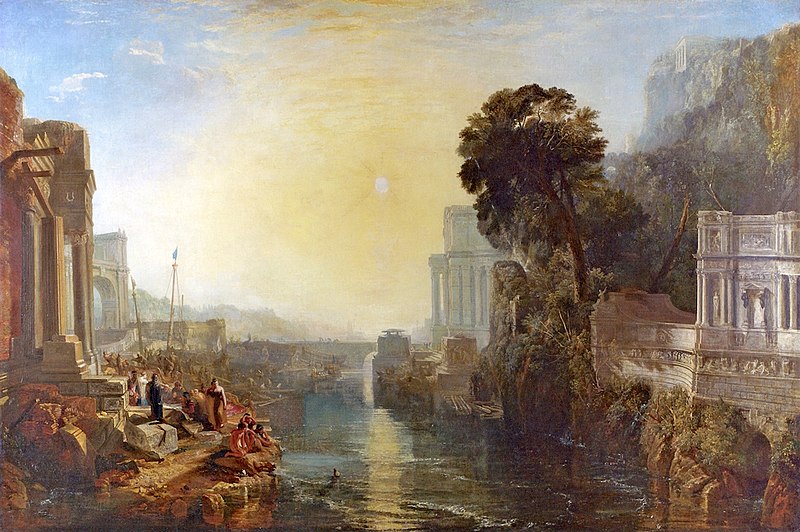
J. M. W. Turner on the Qualities and Causes of Things
O voi ch'avete l'intelletti sani,
mirate la dottrina che s'asconde
sotto il velame de li versi strani. Inferno, IX, 11. 61-63
No one living will love you as you need
 to be loved, and I am talking about
  the sturdiest minds.

Blow into the gallery with a daub
 of red lead and trowel or skip
  it like a shilling on the gray sea.

Say nothing. They will write or call
 and want to know why paint palpitates,
  feels less than the world of trees and seas.

I tell everyone that light is color
 and the world is a veil of poems.

I remind them to rub their pictures
 with a very soft silk handkerchief
  to remove the blue chill of new varnish.

I tell Ruskin everyday how disappointed
 I was to discover that the Sun
  was not God, that my forte and my fault,

the indistinct, belonged
 to God and not to me.

He tells me that the Dean of St. Paul’s refused
 to bury me in Carthage, wrapped in a rotted canvas,
   in my own shroud of lead and light.
Tuesday, April 15, 2008
Day 16--The First of Several Manifestos in the Voices of the Dead

Manifesto One: Van Gogh on the Possible and True*
Even here there is no blue
 without yellow and orange,
  and color must still do everything.

My bedroom (precisely as I have always seen it,
 flat tints and a thick impasto, lilac doors, the green-citron
  pillow and scarlet coverlet, the pale violet
   walls and floors of red, the basin blue
    which requires, as I’ve said, other colors)

Is heaven. I smoke my pipe in bed
 for days on end and live
  in paintings I never have to make.

And there is nothing in my mirror.

*A number of these lines are cribbed/adapted from Van Gogh's letters, as included and translated in Herschel B. Chipp's Theories of Modern Art: A Source Book. As far as I know, Van Gogh wrote no letters after his actual death.
Saturday, April 12, 2008
Day 13--Tim Coe, His Hat, and Touluse-Latrec

Tim Coe, His Hat, and Touluse-Latrec
He was no Renoir, no lover
of malleable light and its glimmer.
He loved the actual women, their skin
their stares, and the grimmer
pimps, and the bends of dancers
old enough to know better.
He was 20; you, my clever friend
have a 19th century hat and 20 years
of being no Toulouse-Lautrec.
So how have you tilted his frame
toward your hatted, rounded, believing
head where a band with no name
plays the greatest hits yet to be written?
And in your poem, the one behind
your bowler, you will love the green
woman, you will be the mostly kind
man on his elbow, with a wall
between himself and the painted
women for whom he longs. Turn away.
That man’s moustache has been tainted
with beer so bitter he tastes it in his sleep.
Go to the gift shop. Get a postcard you can keep.
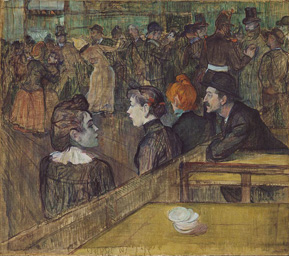
Henri de Toulouse-Lautrec, Moulin de la Galette 1889, Oil on canvas
Art Institute of Chicago
Thursday, April 10, 2008
Day 11--Mulready's Secret Sonnet

The Sonnet, William Mulready (1786-1863) 1839 Great Britain, Oil on panel 35 x 30 cm
Mulready's Secret Sonnet
A moment in this landscape with your heart,
the brook, the grass, the scent, late flowered air,
could make a simple man of lesser art
than necessary pick up pen. Beware,
my flow’r in velvet red of autumn dress,
I’ll spy you as you read, and, if you bark,
the echo of your high-voiced silliness
will prove me as no Dante, no Petrarch,
and show no Beatrice or Laura pure
has joined me in the genre of rough land.
We came here on our own and, to be sure,
this sonnet I have offered to your hand
is scattered in its rhyme, but not its tone.
I’m glad we’re here alone, no chaperone.
note: I think I'd like to write an annotated set of interlinear responses to this hackneyed sonnet. that's a benefit, I guess, of cranking out even the most unfinished piece for now.
Saturday, April 5, 2008
Day 6--Two Suppers at Emmaus by Caravaggio

Michelangelo Merisi da Caravaggio, Supper at Emmaus
c. 1600-01; Oil on canvas, 54 3/4 x 76 3/4 in; National Gallery, London
The worm in the apple gnaws the fruit away,
 and the dressed fowl the men have devoured

by the time Caravaggio remembers the inn-keeper
 and his creased wife, the finer linens

and the pitcher as detailed as the Gospel of Luke,
 and the ridiculously large ears of Cleopas.

What fierce blaze gets fired and glazed
 within the tender  hearted as a stranger paints

the air with his midrash of pigment and time?
 What light layers enough shadow over years?

I am inventing this last part; the rest you could have
 read or been shown on your own:

Caravaggio once punched a drunk in the head
 and saw Jesus as the man’s flesh dented

beneath his fist like a warm loaf. For five years,
 the stranger arose again and again in Caravaggio’s eye.

Caravaggio, Supper at Emmaus 1606, Oil on canvas, 141 × 175 cm Pinacoteca di Brera, Milan
Tuesday, April 1, 2008
30 Ekphrastics in 30 Days
It's National Poetry Writing Month (NaPoWriMo), among other things. I will write an ekphrastic a day for the next 30 days.

April 90th
Scuttled in the wake of Pablo’s Gertrude,
awakened by the turn and term of head,
I head into the April air construed
by 90 airs of Bach strewn through my head.
Thrown hard against the arm chair’s broken arm,
she breaks her brow and plays an April Fool
and fools Picasso like a Harlequin,
and likens then herself to paint. His tools
of eye and self and paint and eye and self
she eyes herself, her velvet coat, her skirt.
He coats her in a gown of browns. She tells
me, Leo, grown and groan and sounds of hurt
sound palatable to a posing girl.
One palette, brother, tints and soils the world.
April 90th
Scuttled in the wake of Pablo’s Gertrude,
awakened by the turn and term of head,
I head into the April air construed
by 90 airs of Bach strewn through my head.
Thrown hard against the arm chair’s broken arm,
she breaks her brow and plays an April Fool
and fools Picasso like a Harlequin,
and likens then herself to paint. His tools
of eye and self and paint and eye and self
she eyes herself, her velvet coat, her skirt.
He coats her in a gown of browns. She tells
me, Leo, grown and groan and sounds of hurt
sound palatable to a posing girl.
One palette, brother, tints and soils the world.
Saturday, March 22, 2008
In Eckersberg's Cloisters

In Eckersberg’s Cloisters, San Lorenzo fuori le mura
The arches move, the light moves.
Three brothers stroll away. A fourth
brings a bushel of fruit from the gardens.
And against a pillar, stairs rising north
from his head, another brother attends
to a text--the arced afternoon light fails
to reach him, no matter how I stand, tilt
my head, cover one eye with this book.
Only a slender lizard lies still and warms
its blood with the sun; the walls, meanwhile,
grow green at the edges, stucco peeled from brick
like skin around a fresh and gradual wound.
First appeared in Ekphrasis
Here's the first draft, from a long time back.
Wednesday, March 12, 2008
If you haven't noticed
I am beginning to post a handful of my own ekphrastic poems. I mean, why not? The course is over and it's my blog, right? Here's an older poem, one that I remembered while trying to write my own poem about David Hooker's ceramic work.
After Her Ceramics Class Results in Many Heavy Christmas Presents from Your Sullen Teenage Daughter
dw
After Her Ceramics Class Results in Many Heavy Christmas Presents from Your Sullen Teenage Daughter
You try to break the gifts while she is gone: heavy, contorted bowls, mugs with no handles.
       Knock them to the floor with malice of accident.
The only lovely cup she made--one that curves like a young boy’s shoulder,
       the one with blue glazes in several shades--leaks.
You learn how a green dish shines in the afternoon light as it flies, before it gouges
      a smile in your stucco wall.
I know you grieve, that you love the wall more than the deadly dish.
I know you wish--small suggestion you’ve held at the back of your throat--for her to give
     you something more delicate, something lighter than a human head.
dw
Saturday, March 8, 2008
For hanging
A Curse--For Hanging--dw
When you hang
your painting
may the hammer scar
your wall, a hole
behind the woman's
pretty head.
When you hang
your painting
may the hammer scar
your wall, a hole
behind the woman's
pretty head.
Notions: Matisse, a Parrot, and the Fate of Wallace Stevens

Matisse has fallen asleep
 in a puddle of pastels.

He awakens at a vast red table
 of his own making.

A bowl of blue lemons
 becomes the center

and also a flower
 imported from a province

of green belief arranges
 herself as another

center—head and torso
 filled with blossoms

requiring no specific pigment
 or love.

So the parrot who rouses
 the prodigal to return

disappears in the  medieval
 sun—splash of several

feathers & losses—and carries
 away Wallace Stevens

dressed in his best white suit
 of cotton, with orchids

pressed in his pockets. Beauty,
 they sing, in a tongue

only the truest believers will know.
--dw
The Museum Guard--David Hernandez

My condolences to the man dressed
for a funeral, sitting bored
on a gray folding chair, the zero
of his mouth widening in a yawn.
No doubt he's pictured himself inside
a painting or two around his station,
stealing a plump green grape
from the cluster hanging above
the corkscrew locks of Dionysus,
or shooting arrows at rosy-cheeked cherubs
hiding behind a woolly cloud.
With time limping along
like a Bruegel beggar, no doubt
he's even seen himself taking the place
of the one crucified: the black spike
of the minute hand piercing his left palm,
the hour hand penetrating the right,
nailed forever to one spot.
From A House Waiting for Music by David Hernandez
Friday, March 7, 2008
The Painting--John Balaban

The stream runs clear to its stones;
the fish swim in sharp outline.
Girl, turn your face for me to draw.
Tomorrow, if we should drift apart,
I shall find you by this picture.
From Ca Dao Vietnam: Vietnamese Folk Poetry translated by John Balaban.
Subscribe to:
Posts (Atom)


